
(II) Restoration — No. 05
Dental Implants
The root stays unseen; the smile is complete.
Replacing the root of a missing tooth with a titanium implant in the jawbone, and its visible part with a tooth made for it.
At a glance
- Surgery
- Usually 30–60 min per implant
- Integration
- Usually 2–6 months
- Anaesthesia
- Local
- Daily life
- Mostly the next day
Durations and visit counts are typical values; they vary from person to person and become clear after an examination.
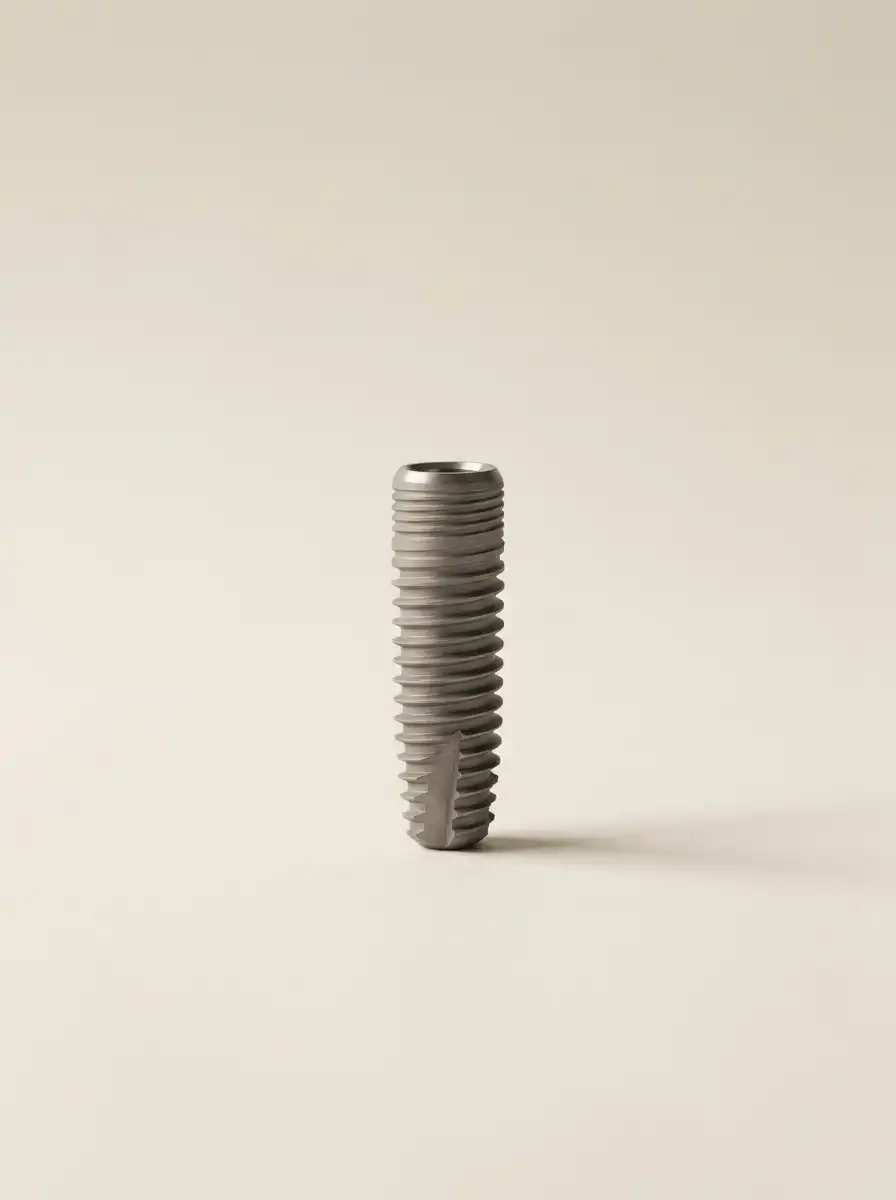
An implant is a small titanium screw that takes the place of the root of a missing tooth. Placed in the jawbone, it fuses with the bone; the tooth made for it then chews, speaks and smiles like a natural one.
The success of an implant is decided on the day it is planned, not the day it is placed. The volume and quality of the bone, the neighbouring teeth, the thickness of the gum and the bite with the opposite jaw are considered together. For the visible tooth to belong to the smile, the frame of the gum matters as much as the bone.
From a single missing tooth to a whole jaw, implants offer a lasting solution without touching the neighbouring teeth.
Who it is for
- Anyone missing one or more teeth
- Those uncomfortable with a removable denture
- Anyone looking for an alternative to a bridge that means cutting the neighbouring teeth
- People whose general health allows a surgical procedure
Options
- 01
Single implant
One implant and one crown in place of the missing tooth, without touching its neighbours.
- 02
Implant-supported bridge
A fixed solution for several missing teeth, without an implant for every gap.
- 03
Full-arch solutions
Fixed or secured dentures on a small number of implants for toothless jaws.
- 04
Bone and tissue support
Supporting procedures such as grafting or a sinus lift when bone is insufficient.
The process
Assessment
An examination, a panoramic X-ray and, where needed, a 3D scan study the bone and the anatomy.
Planning
Position, angle and length of the implant are planned around the tooth — and the smile — it will carry.
Surgery
The implant is placed under local anaesthesia. A single implant is usually a short procedure.
Integration
The implant fuses with the bone; in visible areas a temporary tooth can be worn meanwhile.
The tooth
An impression is taken; the crown, bridge or denture is made to belong to the smile, then fitted.
Follow-up
Regular check-ups watch over the gum and bone around the implant.
—The Dent BB approach
We plan an implant around the smile, not around the bone. First we decide where the visible tooth should be, then design the root backwards from there.
Honest expectations
- Implant treatment is surgery; general health, smoking and oral hygiene directly affect success.
- If bone is insufficient, extra procedures and a longer process may be needed.
- Implants don't decay, but neglected tissue around them can become diseased (peri-implantitis).
- Integration time varies from person to person and from site to site.
Aftercare
- Daily brushing, interdental brushes and, if helpful, a water flosser
- Stop smoking, or keep it to a minimum
- A night guard if you clench
- Check-ups and professional cleaning at least twice a year
Frequently asked
Is an implant painful?
It is placed under local anaesthesia, so you feel no pain during the procedure. Tenderness and swelling afterwards usually ease within a few days.
How long does an implant last?
With sound planning, enough bone and regular care it can serve for many years. Care and habits decide most of its lifespan.
Can I have a tooth the same day?
In some cases, when the bone allows, a temporary tooth can be fitted on the day of surgery. That decision follows the examination and imaging.
Can smokers have implants?
Yes, but smoking harms integration and long-term success. Stopping, or cutting down, before and after treatment is strongly advised.
Is there an age limit?
The jaw must have finished growing. There is no upper age limit; general health is what decides.
This page is for information. A diagnosis and a treatment plan require an examination.