
(I) Aesthetics — No. 02
Porcelain Veneers
Half a millimetre of porcelain rewrites the light.
Thin porcelain layers bonded to the front of the teeth, rebuilding their shape, length and colour.
At a glance
- Visits
- Usually 2–3
- Duration
- 1–3 weeks
- Anaesthesia
- Local, if needed
- Thickness
- About 0.3–0.7 mm
Durations and visit counts are typical values; they vary from person to person and become clear after an examination.
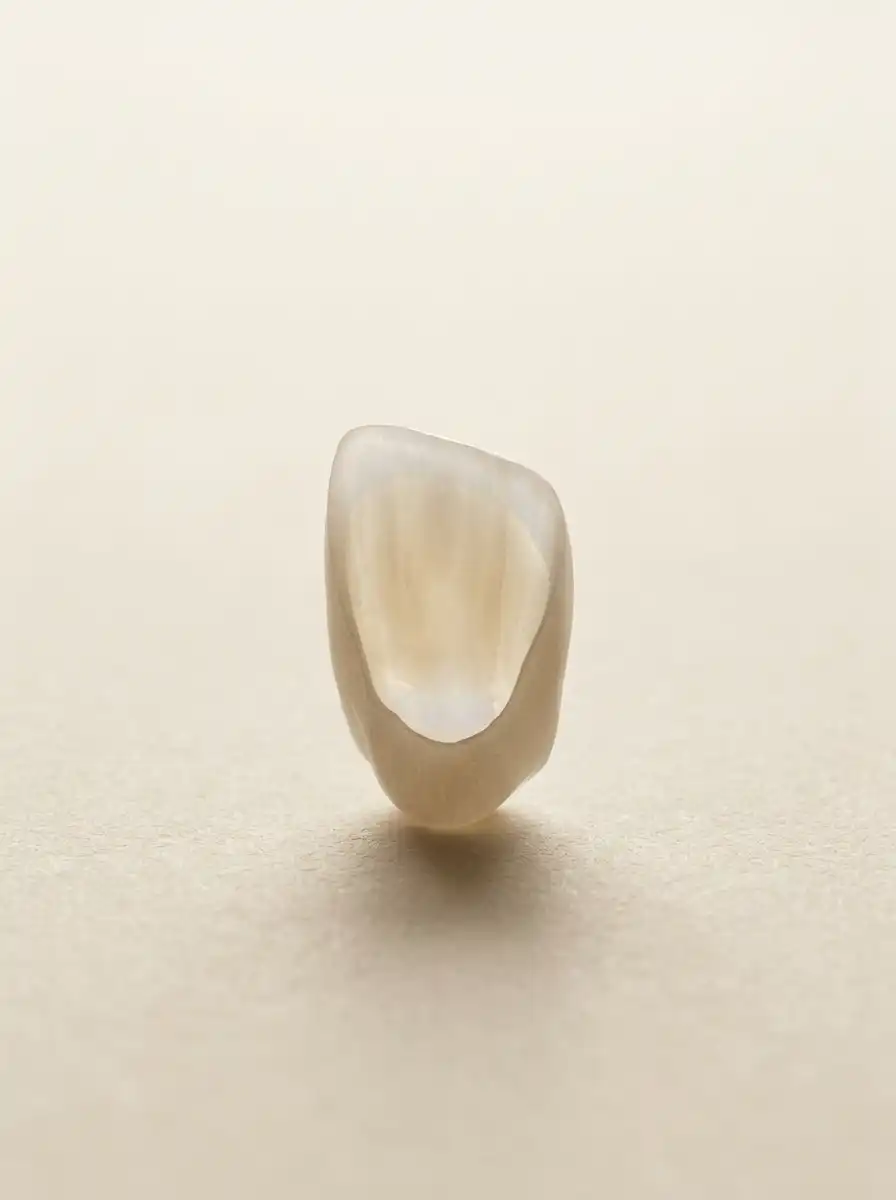
A porcelain veneer is a thin ceramic layer — around half a millimetre — bonded to the front surface of a tooth. In a single gesture it can refine colour, shape, length and small differences in alignment.
What makes a veneer good is that nobody sees it. A natural tooth lets light through in layers; it carries a slight translucency at its edge and a fine texture on its surface. A veneer has to behave the same way. So its colour is never chosen from a shade guide alone, but together with your skin tone, your lips and the whites of your eyes.
Veneers are often part of a smile design, and can also stand on their own. Either way, there is always a trial first: no permanent step is taken before you have seen the result.
Who it is for
- Discolouration that does not respond to whitening
- Worn, chipped or shortened front teeth
- Small gaps and slight irregularities in alignment
- Teeth that look out of proportion in shape or length
Options
- 01
Porcelain (glass-ceramic) veneers
Highly translucent ceramic layers with lasting colour stability.
- 02
Composite veneers
A repairable alternative, applied with very little contact with the tooth.
- 03
No-prep veneers
In suitable cases, very thin layers placed with almost no preparation.
The process
Examination and plan
The health of the teeth and gums is checked; the plan is prepared from photographs and measurements.
Trial
The design is tried in your mouth in a temporary material; shape and length are approved together.
Preparation and impression
If needed, a limited preparation within the enamel is done under local anaesthesia, and an impression is taken.
Temporary protection
The teeth are protected with a temporary layer while the veneers are made.
Bonding
Colour and fit are checked one last time; the veneers are bonded with dedicated adhesives.
Review
Bite and comfort are reviewed a few days later.
—The Dent BB approach
A veneer is not there to cover a tooth, but to correct a flaw that does not belong to it. The less we touch, the better. We always decide on the trial, in front of the mirror.
Honest expectations
- Porcelain veneers are long-lasting, not permanent; they may need renewing over time.
- Where a tooth is prepared, the step cannot be undone — which is why the decision follows the trial.
- With marked misalignment, orthodontics may be the better first answer.
- If you clench or grind, a night guard is recommended.
Aftercare
- Daily brushing and interdental cleaning with a non-abrasive toothpaste
- Don't bite very hard objects with your front teeth
- A night guard, if needed
- Check-ups and a professional polish every six months
Frequently asked
How long do veneers last?
It depends on the material, your oral care and your habits. With good care they can serve for many years; regular check-ups protect that.
Do veneers change colour?
A porcelain surface resists staining very well. Composite veneers may pick up colour over time and need polishing.
Will my teeth be cut a lot?
Preparation for veneers is mostly limited to the enamel, and far less than for a crown. In suitable cases no preparation is needed at all.
What is the difference between a veneer and a zirconia crown?
A veneer covers only the front of the tooth and touches it less. A crown — zirconia included — wraps the whole tooth and is chosen for badly damaged teeth.
Will they feel sensitive afterwards?
There may be some temporary sensitivity; it usually fades within a few days.
This page is for information. A diagnosis and a treatment plan require an examination.